Saturday, April 25, 2009

Trio of Random Yum Recipes


Three things I've made over the last month that were especially yummy and a little different.

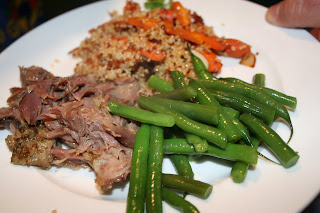
1) The orzo with spice-roasted carrots, currants and pine nuts I almost didn't make because none of us likes cooked carrots, but I needed something for Passover Seder and it worked well with quinoa to go with our Mediterranean lamb shanks. (See me rolling out matzoh to right and results below - not one sign of Passover in our town of 41,000 people so necessity was the Jewish mother of invention. Results - below - were fine, but if you can buy it, you sure don't need that recipe.)


2) The Armenian spice cake I goofed up when making it at my friend Sally's house for supper (called tea here) distracted by wine and giggles -- but it was still really good.

3) And spicy potatoes, which caught my eye, but I didn't realize until I made them that they were really potatoes pretending to be Buffalo wings. Needless to say, they were gobbled up by the boyz in about a second.
~~~~~~~~~~~~~~~~
Orzo (or whatever grain or small pasta you choose) with Spice-Roasted Carrots, Currants, and Pine Nuts - adapted from Simple Cafe Food by Julie LeClerc (another New Zealand find, check her out at www.julieleclerc.co.nz/recipes.htm - more cool recipes there)


1 cup orzo (I used quinoa but couscous, millet, brown rice...lots of things would be lovely here)
4 carrots, peeled
oil to roast
1 t ground cumin
1 t ground coriander
1 t paprika
1/2 cup currants (or golden raisins or regular raisins, chopped coarsely perhaps, would be fine)
1/2 cup pine nuts, toasted
3 T chopped fresh cilantro or parsley
1/4 cup extra virgin olive oil (I used less)
2 T cider vinegar
salt and pepper to taste

Cook pasta or grain of choice per package directions. Drain and set aside to cool, rinsing and tossing with a little oil if your starch has a tendency to glop together when cooling. Preheat oven to 180/350. Cut carrots in half lengthwise and then slice on the diagonal into 1-cm-thick (1/2-ish-inch) pieces. Place in a roasting pan, drizzle with a little oil, sprinkle with spices, and toss to coat. Roast for 30 minutes, remove and cool. Mix cooled starch with carrots, currants, pine nuts, herb, oil and vinegar together well. Season to taste and serve at room temperature. Serves 6.
~~~~~~~~~~~~~~~~
Armenian Spice Cake - loosely adapted from Sally's friend and something we scribbled down from the web. The cake ends up with two different layers: a crust topped with cake, delicious and different. It's nice with vanilla ice cream, softly whipped cream, or good, thick plain yogurt - something they often serve with cakes here that I really enjoy because it balances the sweetness of the cake.


2 cups light brown sugar, loosely packed
2 cups all-purpose flour
2 t baking powder
1 t salt
125 grams butter (about a stick or 8 T)
1 t baking soda
1 cup milk
1 egg
1 t ground nutmeg
1 t cinnamon
1 t ground star anise (plus more of all spices to taste - we probably used almost 2 t of each but it depends how fresh yours are, how much wine you've drunk, etc.)
1/2 cup chopped walnuts

Preheat oven to 180/350. In a medium bowl, whisk together sugar, flour, baking powder and salt. Rub butter into flour mixture until it is the texture of coarse breadcrumbs. Press half the mixture into a well-greased 20-cm square pan (we used 23-cm round or standard medium round cake pan I'd say). In a small bowl, whisk baking soda into milk until dissolved. Whisk in egg and spices. Pour milk mixture into remaining flour mixture and mix well. Spoon into pan on top of pressed in mixture. Sprinkle walnuts over top. Bake for 50 minutes or so. Let stand 15 minutes before slicing.
~~~~~~~~~~~~~~~~
Spicy Potatoes aka Buffalo Wing Potatoes - I hate to admit this but I didn't scribble on the photocopied page where the recipe is from although I *think* it's from a Bill Granger cookbook (Aussie chef) from the very good cookbook collection of my lovely neighbor Chris. The copyright police will come get me now. I mucked with it a bit too.

1 kg (2 pounds) potatoes (I used a waxy variety)
2 T plus 2 t olive oil
1 t coarse salt
1 T tomato paste (I cheated and used ketchup)
1 T red wine vinegar
2 t paprika
1/2 t Tabasco sauce, or to taste

Preheat oven to 220/425. Peel and roughly dice potatoes about 1.5 cm (5/8 inch) in size. Put in a large roasting pan or jelly roll pan and toss with the 2 T olive oil and 1 t salt. Roast for 30 minutes. In a small bowl, whisk together remaining olive oil, tomato paste, vinegar, paprika, and Tabasco sauce. Pour over hot potatoes and toss to coat. Roast another 20-25 minutes or until crisp. Serves 4 - maybe. But I'd say make more. Didn't think to take a photo until they had already been inhaled with steak and green salad.
~~~~~~~~~~~~~~~~
Plus two random cooking tips:
1) Use whisk to stir couscous into boiling water and then to fluff, instead of fork - and it will be fluffier (I know this is from Bill Granger - thanks Bill.)
2) To use up the last bits of mustard in the corners of those expensive Dijon jars I go through so fast I can't quite believe it, shake up a simple vinaigrette in the jar and all the remaining mustard will become part of your vinaigrette. I just squeeze in half a lemon, fill the jar 1/4 to 1/3 full (depending on how acidic you like your dressing) with cider or other mild vinegar, 1 good t coarse salt, grind of pepper, one or two finely minced garlic cloves (depending on size of jar and appetite for garlic). Close jar and shake to mix. Then fill most of remaining jar with mild oil - leaving room to shake. Close jar tightly and shake. Taste and add salt or a touch of sugar if you like to balance.

A Traditional Hangi in Patea


Back in early February, our neighbors Jeanette and Laurie kindly took us to their hometown of Patea, about 45 minutes north of Wanganui, for Waitangi Day, a national holiday commemorating the 1840 treaty between the Maori and the British crown. The town is heavily Maori in population and Jeannette mentioned that a hangi would be cooked and served. Since this is the iconic Maori feast meal – meat and vegetables cooked in an earthen pit by the heat of hot stones ­– I jumped at the opportunity.

In Patea, Jeanette introduced me to the man in charge of the hangi, Ngapari Nui (below on Waitangi Day), a well-known man about town who explained that the meal they had cooked that day for 400 was not prepared in the truest traditional manner and invited me to call him about a more authentic hangi in the planning stages. I’m not sure if he expected me to take him up on his offer, but when I called he seemed to remember making it and was gracious.
Over the phone, Ngapari told me that the upcoming hangi was for a visiting group of Americans. Too bad, I thought. “From Hawaii,” he added. More interesting. He invited me for the powhiri – ritual welcoming ceremony mentioned previously in blog – that would start the day and welcome the group onto the Patea marae (Maori meeting house and its grounds). Even though it required a little son-juggling to leave early enough, one just doesn’t decline an invitation to a real marae powhiri (staged ones for tourists are available for a charge at locales across the country). My friend Margo joined me and we drove up to Patea early one Tuesday morning a couple weeks later to meet Ngapari in front of the dairy (corner store). In contrast to the first time we met, he was all dressed up in a nicely pressed shirt and, as we waited to head to the marae, he explained a little about his role and his town.

Ngapari is chairman of the local group of Ngati Ruanui, his iwi (tribe). “I’m the yes man,” he clarified with a wry smile. His surname, Nui, means great or large. He would disclose his age only in Te Reo (the language of Maori), which I struggled to transcribe at the time, but I now know he’s 45 since I just learned numbers in my Te Reo class. (Incidentally, the fact that this class exists and can be taken, free of charge, by any Kiwi is in and of itself a sign of changing times. See sidebar below.) The town of Patea was the original landing point of one of the huge wakas (canoes), the Aotea, that brought the first Pacific Islanders down to New Zealand and it served as a very busy port through the early part of the 20th century. (See waka on main street and coastline below.) It is now down to about 1,000 in population with, unfortunately, not much in the way of local jobs since the main employer, the freezing works (meat processing plant), closed in 1982 after nearly 100 years of operation when meat processing became more centralized at larger plants. (See photo from the freezing works museum in town.) Patea is still surrounded by farms and rolling pasture land, but the nearest source of work is up in Eltham at a huge Fonterra dairy factory.


A small schoolbus drove by as we spoke and Ngapari waved to the kids. “We’re quite lucky to have our school still,” he said. “We fought to keep it open.” Many of the young people move away to find work, or just don’t work. “Now we got our people spread out over the world,” Ngapari said. “My three sons,” he added, “I had to send them away.” One is in London, he explained, and two in Australia. This is quite common among families of all backgrounds in New Zealand. Salaries and opportunity are very often better elsewhere; ironically, the depressed world economy gives Kiwis hope that more of their own will stay closer to home.

SIDEBAR: When Jeanette and Laurie first met Ngapari a number of years ago, they knew him as Barry. As with the Native American culture in the US, Maori language and traditions had been ignored at best and repressed at worst, both officially and unofficially since the mid 1900s. It has not been until fairly recently, over the last 15 years or so, that there has been more general recognition that the indigenous traditions should be appreciated and celebrated. Preschoolers of all backgrounds now learn to count in Te Reo Maori and ceremonies like the powhiri have been adopted by many community organizations – like our welcome at the hospital and Nikko’s at the high school. There remain, of course, plenty of cross-cultural issues and bridges to be built. The discussion going on in our town right now about whether to add the h into Wanganui to make it Whanganui has both sides bristling over charges of cultural imperialism and political correctness.
(This is the photos of the day of the hangi on the marae. I'm trying this a different way - as a slide show rather than individual photos.)

We followed Ngapari and arrived at the Wai O Turi Marae, which is used by three local iwi as their meeting house. It is positioned on a cliff right above the ocean and had been a historical village site and marae until the Maori lost it in the 1870 land wars. Although post-war agreements pledged it back to the iwi, Ngapari said, that didn’t happen until 1936. “They also stopped a lot of our traditions like going to get eel in the rivers,” he added. As is customary, strangers do not enter the gates until they have been officially welcomed so we waited in steadily heavier drizzle for the Hawaiian group to arrive, at which point we were called in song through the front gate.

Along with a substantial number of local iwi members, the powhiri ceremony was also attended by about a dozen preschoolers and their teachers at the marea-based school. Old photographs hung on the walls and everyone, except for the elders, sat on mattresses lined around the edge of the room. We were all welcomed in Te Reo Maori by a representative of the local iwi and then, to my surprise, the visitors responded in a language that sounded like Te Reo to me as the local hosts nodded in comprehension. I found out later that they were speaking Hawaiian and that the shared Pacific Island roots of the two groups allow them to understand each other despite the roughly 800 years since the ancestors of the first Maori climbed into their wakas for the long canoe south.
The Hawaiians, it turned out, were part of a First Nations’ Futures Program fellowship through the Kamehameha School in Maui who were using their diverse expertise in law, education, agriculture and environmental issues to reinforce the leadership and stewardship roles of their own indigenous people. (See www.fnfp.org for more info.) As one of them said, “The land is our chief; we are the servants.” The children behaved very well until the end of the hour-plus ceremony when the fidgets hit. One toddler amused the crowd by dancing by himself in the middle of the room as everyone spoke. His father (I think), one of the organizers, was not as amused.

After a tea and sausage roll break, the Hawaiians went off to hear about river restoration projects from the local Department of Conservation while I made a beeline to the group building the large fire that would heat the rocks, the first step in the hangi that would be served for supper that evening. Anthony (Antz), who was leading the "laying down,” was a striking young man with plentiful tattoos and equivalent patience with my many questions. (He did admit to my friend Margo that he had added some of the newer tattoos to cover up some older gang-related ones.) The rocks would heat in the fire for two hours to get “white hot,” he explained, as a couple of his colleagues including Kingi, Antz’s nephew who didn’t look a lot younger than him, Wuzz with some fine rasta braids, and Rangi, in a Harley sweatshirt, finished digging the pit . Antz soaked cloths in a large barrel; they would cover the hangi after it was placed in its earthen pit. One of the Hawaiians had wandered over to watch and noted the similarity to the Hawaiian imu, or earth oven. It is, in fact, called an umu in Te Reo Maori. Steaming food with hot rocks and vegetation in a dug pit has equivalents all over the world, including the New England clambake. A history of New Zealand food I have read notes that the first Europeans to land here were impressed with the practice, which was more sophisticated and efficient than the open-hearth cooking used predominantly back home.

Ngapari and his energetic and mischievous grandson, Te Pou Tokomanawa (meaning, as his grandpa explained it to me: Pou means post, Toko means support and manawa is heart, "in other words I see him as my support for the future in carrying the things that I teach him") –who lives with Ngapari and his wife, Tina – showed me the veges (not veggies) prepared for the hangi: pumpkin, squash, kumara (traditional sweet potato), and potatoes. As the rocks heated, Antz wove piles of puka leaves through the wire basket to encase the hangi. The food is most definitely steamed, not roasted, thanks in part to whatever greenery is used to wrap it – cabbage leaves more commonly now, but also wild watercress, and the traditional puka leaves. Although New Zealand has much ocean coast, no one I’ve spoken with had ever heard of using seaweed.

Marty Davis (in blue t-shirt with iwi elder in photo slide show above), Ngapari’s equivalent for another of the local iwi, spoke with me as we waited. Traditionally, Marty said, Maori see land “not as an asset on the balance sheet, but as a treasure or taonga.” He was clearly practiced in his message, quite articulate but also honest. “We have a generation of some lost souls,” he acknowledged. “So we are concentrating on the next generation, helping them understand, ‘Who am I and where am I from?’” The revitalization of the language is key, he said, as was being politically organized: “Education leads to awareness. Awareness leads to tolerance. Tolerance leads to a better society.”

Ngapari’s wife, Tina Nui, was one of the efficient band of women working behind the scenes in the kitchen to prepare the food that would go in the hangi and be served with it. Traditionally, men handle the fire and cooking and women the food prep. Tina is known for her famous creamed paua (abalone), which would be served as the first course of the hangi meal. The local Maori always collected abalone from the ocean, she explained, but now must get a permit. Another traditional seafood the Maori gathered was kina, sea urchin. “Back in the old days we were taught to eat the whole thing or leave it alone,” Tina told me. “Now people just eat the yellow bit. If old people saw that, they’d slap you on the neck. I was brought up to eat the whole lot. I like it nice and fresh out of the ocean.”

Since unfortunately we could not stay to taste the hangi itself – much to the disappointment of our hosts and us – Tina did give me a sample bowl of the creamed paua, which was delicious. It was reminiscent of a really good, thick clam chowder with a bit more flavor and no potatoes. Tina starts with onions, chopped up abalone sauteed in butter and then adds milk, cream, a little flour and some spices. “I'd take a bowl of Tina's creamed paua over a hangi any day," said Antz.

The stones were ready and the hangi basket was filled with meat: huge sirloins (butt), rolled pork bellies, and whole chickens. The netted bags of veges went on top along with a bag of stuffing. The basket was lain in the pit and then the crew set about raking the hot stones into the pit, very hot and sweaty work. After the stones were in, the hangi was covered completely with sopping wet sheets and then wet gunnysacks after which dirt was shoveled over it to prevent any steam from escaping while it cooked for about 3 hours.

The meat from a hangi is very tender with a pervasive flavor of smoke and the vegetables soft enough for a baby to eat. Although I did not get to taste this one, the one we ate on Waitangi Day in Patea (see below) was fork-tender and quite smoky, if a little bland. I hold out hope that I will still get to taste a traditionally cooked one before leaving in July. Hangis, Antz told me, are a celebratory meal for Christmas, New Year’s, 21st and 50th birthdays. It’s an easy way to cook for a crowd, he said. “It saves a lot of catering. It’s just natural. It’s just how we are.”


Tuesday, April 7, 2009

Alex's Turn


And now for Alex's words, which were actually published in the Wanganui Chronicle last week. He wrote this in response to a request from his teacher who had been approached by the local newspaper for a "good news" story at the school.


My name is Alex and my family and I moved to Wanganui from Vermont, U.S.A. in January to live for seven months. For the past two months I have been going to Wanganui Intermediate School. Although it was hard to leave my friends at home, I was excited to try going to school in a different country, and it has been great so far, better than I thought school could ever be. At WIS, I have been able to try many new things such as robotics and ukulele. I really love doing robotics and Mr. Szabo is an awesome teacher. Also, in Vermont we didn’t have swimming at school because we were not on an island surrounded with water, so it wasn’t as important. I must admit that I am not so good when it comes to swimming but it turned out that it wasn’t all that bad. My teacher, Mrs. Zander, is extremely nice and she encouraged me to actually try. Also, the kids in my class are very welcoming and I’ve already made some friends that I know I’ll have forever. I’ve been thinking that I might like to come back and do an exchange year when I’m in high school. – Alex Pasanen, age 11

Thursday, April 2, 2009

This is a speech Nikko wrote for English class here - presented with a multimedia slide presentation of photos of Vermont, foliage, cows, ski slopes, etc. along with a tin of maple gingersnap cookies made from real Vermont syrup we brought with us. It's always interesting to think about home when you are far from it.


My Home State


Vermont. Probably not the kind of place you all think of when someone mentions the United States. No, there aren’t any skyscrapers, billboards, four-lane highways or anything like that. Let’s just say Vermont is different. Now don’t get me wrong here, there are people in Vermont, but to most Americans, Vermont and “the middle of nowhere” are a pretty good fit. This is assuming, of course, that they’ve even heard of Vermont in the first place.


Anyway, Vermont is located in New England which is in the northeast corner of the U.S. Specifically; Vermont is right around Massachusetts, New York, New Hampshire, and right under Canada. Here let me show you on this map. As you can see, it is quite small, resulting in the second smallest population out of all the states with a mere 660,000 people, about half the size of Auckland. As I said, people do live in Vermont, with the largest city, Burlington, just a bit bigger than Wanganui. I myself live in South Burlington, which hopefully you all are smart enough to figure out, is just south of Burlington. Here’s a map of Vermont to show you.


Meanwhile, I’m going to tell you some facts about Vermont.
· Vermont is the largest producer of maple syrup in the United States. You only get Canadian maple syrup here in New Zealand, but it’s unfortunate because Vermont’s is definitely way better.
· Vermont is a farming state. It has the highest ratio of cows to people in the United States. Kind of similar to New Zealand with sheep.
· Vermont is home to the famous ice cream company, Ben and Jerry’s, and the global snowboarding company, Burton.
· The capital of Vermont, Montpelier, is the only U.S. capital without a McDonalds.
· Vermont is called “The Green Mountain State” even though the mountains there probably look like hills to you Kiwis. (Our highest mountain is Mount Mansfield at 1,335 meters, which wouldn’t even come close to the top 50 in New Zealand.)
· Vermont was the birthplace of two former U.S. presidents, Calvin Coolidge and Chester A. Arthur. I told you people do live in Vermont.
· Lake Champlain, bordering the west side of Vermont, is the sixth largest freshwater lake in the U.S. It is almost twice as big as Lake Taupo and has its own version of the Loch Ness monster called Champ.


There are also many fun activities to do in Vermont. Here are some of them: First of all, Vermont has many popular mountain biking tracks. This is mainly because the ski resorts need business in the summer and the ski trails are also great for mountain biking. This is great fun for the adventurous. Another popular activity in Vermont is tramping. During autumn, the foliage is amazing; with the colorful leaves providing a great backdrop for a good tramp in the Green Mountains. This is one of our great fames as a state. But let’s not forget the winter. Vermont provides the far best skiing in the northeastern part of the U.S. People come from states all around to visit the ski resorts. Some of these are Stowe, Jay Peak, Killington, and many more. And skiing is quite different in Vermont than in New Zealand. Have you ever thought about skiing through the trees? Well that’s how we do it in Vermont. Here let me show you some pictures of the Vermont ski slopes. Anyway, if you’re not up for downhill skiing you can always cross-country ski or even take a tramp in snowshoes.


So as you can see, Vermont is probably a different look into the United States than you might have expected. But even though it is located in the “middle of nowhere” there is plenty to do and see. So if ever go to the U.S. and you’re near Vermont, you might just want to make the side trip. After all, it’s the great place I call home.

Wednesday, March 25, 2009

Loads of Lemons


Lemons, lemons everywhere (with some strawberries thrown in for good measure...)

In addition to the lemons we “rescued” from our absent neighbors’ tree a few weeks ago (see blog post of Feb 21) and a few times since (irresponsible to let them rot), another neighbor, Jeanette, took a week of holiday and left us a huge basket of lemons from her father’s tree.

I love all things lemon, but even to me, the pile was quite daunting. Nothing to do but get on my lemony way.


First I made a double batch of Nigel Slater’s Demerera Lemon Cake with Thick Yogurt. The recipe name alone sounds good enough to eat. I have fond memories of demerera sugar from childhood when Lex and I would mush the crunchy golden crystals into softened butter and eat the mixture by the spoonful. I loved how you caramelize the lemons for the top and the cake had beautiful texture from the ground blanched almonds (you can buy them already ground in the supermarket here – not in Vermont I don’t think?). He also uses the time-honored technique of poking the oven-hot cake with a skewer and drenching it in citrus syrup. Salivating yet? Recipe below.

[Major aside: Have I mentioned already how much I love Nigel Slater? I owe the Wanganui library for 10 days of overdueness on his stream of food consciousness, slightly-more-robust-than-twitter-but-not-overly-verbose daily eating and cooking journal, The Kitchen Diaries, which I pored over every night in bed for about a month until Mark said, “How can you just read recipes like that night after night?” (We’ve only been together for 25 years and this is not a new habit.) Other recipes of Nigel’s – lemony and not – that we have recently tried and loved include Chicken Patties with Rosemary and Pancetta (a great easy weeknight supper and huge hit with all three boyz who begged that I not just make it once in their lives and move on as I tend to do), Pork and Lemon Polpettine with a secret flavor punch of finely chopped anchovies, and Strawberry Mascarpone Tart – elegant and easy and not too sweet, which I really appreciate. (See photo below - even though it isn't lemon.) The Roast Pork Sandwiches – a slab of belly roasted with peppercorns, fennel, bay leaves, and lemon juice piled on good bread (I found some!) with arugula (rocket here) and thick slices of summer tomatoes from the market – were really good too, but the kids couldn’t quite deal with all that belly fat. I’ve got to try the Roast Lamb with Anchovy and Mint too, but my family is a little lambed out right now. ]

I also made the kids’ favorite: lemon squares, although the recipe I found on the web seems to be a bit eggier (4 eggs?) than the one I make at home (Does anyone have a perfect one to share with me?) and, for the lovely ladies in my knitting, spinning, and weaving Wednesday group, a slightly messed-with version of a Lemon Yoghurt Cake.

This recipe came via Chris, another food-loving neighbor, from an Alison Holst cookbook; she’s a New Zealand icon in the kitchen. You’re supposed to bake it in a tube pan but I don’t have one here so used a large springform and made Nigel’s caramelized lemons (doubled with one lemon and one orange) to form a decorative circle on the top. I overbaked it a touch because I forgot to set the timer for the last 10 minutes, but it was still delicious, with the super-caramelized fruit, chewy and almost toffee-like on top.

On the savory side, I had already made a big batch of preserved lemons but, with this new harvest, I made another two jars, one for Jeanette and one for my friend Margot. I love preserved lemons; they are simply the best combination of salty and puckery and so simple. See method below. This is a basic recipe. Some recipes include hot chile peppers, star anise, cinnamon etc. but I like mine straight up for most flexibility.

You need a large super-clean glass jar with tight-fitting lid. Figure out how many lemons will fit in it quite tightly. Wash the lemons well – and don’t even think about doing this with sprayed lemons. Put a kettle on to boil. Cut each lemon like a flower into quarters but leaving the stem end intact. Get a bowl of non-iodized coarse salt (sea or kosher) ready and use your fingers to fill each lemon “blossom” with about a tablespoon, placing each filled lemon in the jar as you go. Squeeze the juice from another set of lemons - half the number of lemons you have in the jar and pour that lemon juice into the jar. Fill the rest of the jar with boiling water, sliding a clean knife around the side of the jar if necessary to make sure no air bubbles are taking up space. Screw lid on tightly. Let jar sit on counter for about 10 days, turning it upside down every day to redistribute juices and salt. Then refrigerate and start using. Notes for use: always use a clean fork to remove lemons from jar, rinse preserved lemons before using, and always remove flesh before using -- it’s the rinds you want.

The photo at left is a recipe test I did for a food friend, Deborah Krasner, who is finishing up a tome on cooking all parts of the animal back in Vermont. It is a lamb shank tagine with green olives and preserved lemons along with some cinnamon, ginger, cumin, and saffron and only water to braise. It took all my willpower not to throw in a little wine or stock, but after aggressive reduction and fat-skimming of the final sauce, it came out quite delicious. (Deborah assured me, after the fact, that the recipe comes by way of Mediterranean cooking goddess Paula Wolfert and that water is authentic, which I figured.) You’ll have to wait for her book to get this particular recipe, but if this has whet your appetite, lamb tagine recipes using preserved lemons are plentiful.

Other things to do with preserved lemons:
· Blend a vinaigrette with the salty, briny punch of preserved lemon. Whiz the rinsed peel of half a preserved lemon in a blender or processor with 1/4 cup olive oil, a tablespoon of fresh oregano or parsley or cilantro, freshly ground pepper, a pinch of sugar, 2 T lemon juice, and a little water . Depending how salty your lemons are, you may not need to add salt. Inspired by Bill Granger, Bill’s Open Kitchen. Serve on a sturdy salad or with fish, chicken, and pork.
· Roast a whole chicken with a rinsed preserved lemon rubbed over the skin and then put in the cavity, or chicken pieces with slices of rind tucked among them.
· Make a preserved lemon and tomato salsa to serve with fish – from the gorgeous NZ Dish magazine try this: ½ small red onion, thinly sliced and soaked in water for 15 mins, drained, squeezed dry + 3 quarters of preserved lemon rinsed and scraped of flesh and thinly sliced + 2 tomatoes, halved, seeded, and sliced + 2 T lemon juice + 3 T olive oil + 1 clove crushed garlic + ¼ tsp toasted cumin seeds + ¼ tsp sweet paprika + 2 T chopped coriander. Mix together and season to taste.
· Whip up a preserved lemon mayo by folding a couple tablespoons or so of finely chopped rinsed rind into 1/2 cup blend of mayo and crème fraiche (or sour cream) and a small handful of chopped dill or chives to serve with grilled chicken breasts, chicken burgers, salmon, or salmon cakes (thanks to Taste.com.au for this idea)
· There’s this great pasta recipe in Cooking with Shelburne Farms: Pasta with Sweet Peas and Morel Mushrooms. It has cream and tarragon and lemon in it too. After we developed it for the cookbook, Rick started serving it at the Inn in a restauranty version enriched with a dollop of crème fraîche and he used finely minced preserved lemon rather than the lemon zest.


OK, I’m hungry now.


TWO LEMON CAKE RECIPES


Demerera Lemon Cake with Thick Yoghurt
by Nigel Slater from The Kitchen Diaries


Abridged from headnote: Serve with thick Greek yoghurt or tart crème fraiche. Use unwaxed or organic lemons. My note: US measurements in parens.

For the topping:
a lemon
demerara sugar – 2 tablespoons (soft brown sugar fine here)
water – 4 tablespoons

For the cake:
butter – 2oog (about two sticks)
demerara sugar – 200g (use soft brown sugar although it’s not quite the same, a scant cup)
plain flour – 90g (2/3 cup)
ground almonds – 90g (2/3 cup)
baking powder – ½ teaspoon
a large lemon
large eggs – 4

For the syrup:
demerara sugar – 2 tablespoons (soft brown sugar fine here)
the juice of a large lemon

Set oven to 160 degrees centigrade (320 degrees F). Line a large loaf tin with baking parchment (simply cut a piece of paper the exact length of the tin and lay it inside the tin and up the longest sides). To make the topping, slice the lemon thinly and put it in a small saucepan with the sugar and water. Bring to the boil, then watch closely for five minutes or so, until the water has almost evaporated and the lemon slices are sticky. Set aside.

Beat the butter and sugar together in a food mixer till they are light and fluffy. [I managed this all with a hand mixer, which is all I have here.] You can expect it to take a little longer than it would with caster sugar. Meanwhile, weigh the flour and almonds and mix them with the baking powder. Grate the lemon zest and add it to the flour mixture. Break the eggs and beat them lightly with a fork, then add them to the creamed butter and sugar a little at a time. The mixture will probably curdle a bit but don’t worry. Remove the mixing bowl from the machine and gently fold in the flour, almonds and baking powder with a large metal spoon (a wooden spoon would knock the air out). Scoop the cake mixture into the lined tin, then lay the reserved lemon slices on top, overlapping them down the center of the cake. Bake for 45 minutes, till risen and golden. Insert a metal skewer to see if it is ready. If it comes out clean, then the cake is done; if it has mixture sticking to it, it needs a few minutes longer. Remove the cake from the oven and set aside. For the syrup, stir the demerera sugar into the lemon juice; it will only partially dissolve. Spike the top of the cake with a metal skewer, then spoon over the lemon and sugar. Leave to cool.
~~~

Citrus Yoghurt Cake
Adapted from Alison Holst’s Lemon Yoghurt Cake

For topping: make Nigel’s caramelized lemons above – doubled with one lemon and one orange
For cake:
1¾ cups sugar
rind of 1 lemon and 1 orange
2 eggs
1 cup oil (I used half canola and half olive oil)
½ tsp salt
1 cup yogurt (I used Greek whole milk plain – she says use whatever you want including flavored, but I’m a purist)
3 T lemon juice
2 cups self-raising flour (you can find this in US or use 2 cups a-p flour, 4 teaspoons baking powder, and 1/2 teaspoon salt)

Preheat oven to 180 c (350 f). Easiest to use food processor: Process sugar and rinds together until finely chopped together. Add the eggs, oil, and salt and process until thick and smooth, then add the yoghurt and lemon juice and blend enough to mix. Add the flour and process just enough to combine. Pour cake mixture into buttered and floured pan (bundt or large springform). If using springform, lay caramelized fruit, alternating lemon and orange slices, in circle on top of cake. Bake for 30 mins (more like 45 if not in bundt), until a skewer comes out clean.
~~~

Wednesday, March 18, 2009

And what do you do after such an amazing day?

Well, the day after the hike the boyz went white river rafting while Margo and I meandered around the town of Tokaanu near Lake Taupo, where we soaked ourselves and our sore legs in natural hot spring pools and had a serendipitous morning tea in a vineyard. The division of activity worked for everyone.
Alex's favorite part was jumping off this waterfall...although the soak in the private hot spring at the end of the excursion was also fun...as was the excitment of riding the rapids.


And now for the non-adventure side of things:
Before the hot pools, while searching for a cup of coffee, Margo and I stumbled into a small, picture-perfect, family-run vineyard where Jenny, sister of the owner, kindly offered us tea and warm slices of her mother's wartime fruit cake. The vineyard produces Pinot Noir, Reisling, and Chardonnay grapes, she explained, but her brother has outsourced winemaking to someone over the last couple of years so that he can care for his wife who has Alzheimer's. Jenny was there visiting from Herefordshire to help with her sister-in-law and relieve her brother a little and, by her own admission, was pleased to have the distraction of visitors. In addition to the cake recipe, she also shared a promising sounding recipe for celery and blue Stilton soup. (As opposed to white Stilton, she said. Who knew there was such a thing?)

After the boys white water adventure and our hot water adventures (teacups to soaking pools), we joined forces again to stroll through the Tokaanu Thermal Walk where I finally managed to capture the oozing glory of bursting hot mud bubbles on film.


If it had only been chocolate....

Tuesday, March 17, 2009

Tongariro Alpine Crossing March 14, 2009

By the numbers: Seven hours, 19.4 km (12 miles) ascending to 1,886 metres (5,905 feet), 800 of which we actually climbed around and across three mountains, stunning jade-green lakes, rust-red craters, moonscape, and alpine tundra fueled by 10 peanut butter and jelly sandwiches, six plums, five apples, a dozen really good homemade peanut butter-chocolate chip cookies (NYTimes version of Cook's Illustrated recipe) and a bunch of neon sour gummy worms (among other things). Just our party of 5 (including my Kiwi friend Margo) and another 1,500-odd trampers doing the Tongariro Alpine Crossing, named one of the best one-day hikes in the world. Oh and the weather could not have been more perfect. The experience was truly a highlight of my life -- and I think the boys would agree.

The shuttle bus to the start of the hike (tramp in Kiwi-speak) picked us up at 6:55 am and we started on the trail around 7:30 am well fueled with coffee and bagels (yes, I found some decent ones here). It was quite lovely to be up there so early -- although we were far from alone...


as you can see by the long line of hikers in front of us heading for Mount Ngauruhoe, best known for its cameo as Mount Doom in The Lord of the Rings movies.


Mount Ruapehu bathed in early morning sunlight. This is our closest ski slope too -- about two hours from home here in Wanganui.


The boys all bundled up at the start - it was cold with a sharp wind in places. Thank heavens for our good friend Margo, who came with us, and had piles of extra gloves, hats, etc for us to borrow. (Not to mention that she found us a perfect apartment to stay in for the weekend and arranged all details. We're in a bit of travel-planning overload.)


The weather on these mountains is notoriously changeable and can be quite dangerous with visibility going from good to zero in the space of an hour, but Margo had efficiently arranged for perfect weather too.


Mount Doom with a recent dusting of snow, very early this year.


We came from down there!


Me, in red, and Margo, in orange a few hikers back. This uphill chunk at the beginning was not a piece of cake, but it was a good work out. The diversity of ages, levels of expertise, and languages on the track were quite amazing. (Margo got into a nice chat with guy in front of her about his sexy legs...although, ostensibly, she was asking him where he got his legwear.)


Despite growing up less than 90 mins from this hike, Margo had never done it. (She does point out that she lived thousands of miles away in London for 30 years but I still gave her grief, of course.)


Across moonscape, up rocky hill.


As we climbed higher, the volcanic formations and rocks were fantastic, not to mention the views of terrain. I wished for a 360 -degree lens.

Halfway through, shedding layers, staying motivated through strategic deployment of snackage and the awe-inspiring views.

On a clear day, you can see Mount Taranaki, which is about 80 miles away - as this picture managed to capture.


The first view of the Red Crater - one of those sights that photos water down from their true-life brilliance.
Nikko snapping away - the boys were truly impressed by the grandeur and diversity of the landscape we covered.


The Red Crater with Mount Ngauruhoe behind.

The Blue Lake.

Descending, very gingerly, the skree (very loose gravel) to the Emerald Lakes. Alex and Mark followed the example of some who merrily ran down the hill, ignoring the fact that one poorly placed step could send you somersaulting down the precipice.


Margo, almost at the end of the skree, which must account for her smile. Although those gorgeous lapis lakes might have something to do with it too. (It probably wasn't the strong smell of sulphur that arises from the craters around the lakes.)

This actually captures the color pretty well. They are just breathtaking. Their vibrant color comes from the minerals in the volanic earth and they freeze in the winter in that hue.


Looking back from whence we came. Red Crater, backed up by Ngauruhoe, and then Ruapehu, which is incidentally quite an active volcano with the last major eruption in 1996. (In Maori, the name means "pit to explode.")


Specks on the crest to the right are hikers at, I believe, the highest point of the hike at 1,886 meters. Yes, we were there.
White gentian flowers like this one were blooming along the lower track in many spots, although the alpine plant life is relatively sparse and not very colorful. Apparently, most alpine flowers are yellow or white because their pollinators - moths, flies, and beetles - do not have the same eye for color as do butterflies and bees.

View on the descent of Lake Rotoiara and then Lake Taupo in the distance.

The last hour in the sunshine but still some wind. It was gorgeous, but a little anticlimactic said the boys.


The steaming Ketetahi Springs on sacred Maori land passed on the way down.

A final view as we near the end framed by the omnipresent flax seed pods - the leaves of the plant were used in traditional Maori weaving of baskets, rugs, and capes.